
Searching Douglas County Criminal Dockets
Minnesota Court Records Online, or MCRO, is the remote starting point for a Douglas County criminal docket. Pick Name when no case number is handy. Choose Person or Business, and set Court Location to Douglas. A last name alone works, though a first or middle name narrows it. Wildcards after two characters and Sounds Like are tools to use one at a time, never together. Category and filed-date limits also cut unrelated matches.
Have a case number? Use it in full. MCRO forgives dashes and leading zeroes but rejects spaces. A citation number is a separate route when it was issued before the court case number existed. Before opening Case Details, confirm the county, filing date, category, party role, and number. Results default to Newest First. Switch to Oldest First if needed. The list stops at 200, so narrow a broad name search rather than trusting it as complete.
- Open MCRO Case Search and select the mode that matches the information in hand: Name, Case Number, Citation Number, or Attorney.
- Set the Court Location to Douglas County and choose Criminal when the case category is known.
- Open the matching result with View Case Details and inspect the Register of Actions, charges, hearings, and disposition.
- For a scheduled appearance, compare the hearing result with the official Douglas calendar and the notice or order in the case.
- Contact Douglas County Court Administration for an official copy, a case-specific question, or help with a restricted record.
Note: When several people share a name, the Douglas County filter plus an exact case number beats a broad name search for a criminal docket lookup.
Douglas Criminal Docket Name Limits
A missing name result deserves a second look. MCRO can suppress pending criminal, traffic, and petty-misdemeanor matters without a conviction in a defendant-name search. The full case number can still pull a limited result. A citation number can reach the court file after filing. Punctuation can hide a case. So can aliases, a wrong county selector, a protected category, or restricted remote access. No remote listing does not mean no Douglas County criminal case exists.
The official MCRO access overview separates public remote access from the court's certified record. When a name search stalls, strip punctuation and enter the case number exactly. Try a date range. Or call Court Administration. For a same-day hearing, rely on the Douglas calendar rather than a saved search screen.
Inside a Douglas County Criminal Docket
Case Details speaks in Minnesota's own docket language. The Register of Actions, labeled Case Events, is the chronological history of filings and court activity, and it can tie a dated entry to a Document Index Number and a document available remotely. The detail view also gathers case information, parties, warrants, charges, interim conditions, hearings, dispositions, bond or bail activity, and financial information. Party roles matter here. A listed person might be a defendant, victim, or witness. They could be an attorney or another participant.
| Case number | The unique court-file identifier; use the number shown on the notice rather than trying to rebuild a format. |
|---|---|
| Case information | Includes filed date, Douglas court location, case type, status, judicial officer, and any citation number. |
| Charges | Shows charge history and, where recorded, amended or current charges. Read this with the disposition. |
| Case events | Dated filings, orders, settings, payments, and other activity in the Register of Actions. |
| Hearings and result | Shows scheduled or prior hearings and the recorded disposition, not merely a case-status label. |
| Financial and bond data | May show fines, fees, payments, credits, bond, or bail activity; none of those fields alone establishes guilt. |
Copy a number printed on the court notice, such as a number printed on the court notice, exactly into the matching MCRO search mode. Douglas criminal numbers follow no one universal pattern. A constructed format would mislead more than help.
Douglas Criminal Docket Process
Douglas County's gross-misdemeanor process explainer lays out the local sequence behind many criminal case events on a docket. A law-enforcement officer and a judge sign a complaint, which then goes to the Court Administrator for filing. At the Rule 5 first appearance, the defendant learns the charge and relevant rights. These include counsel and public-defender eligibility where it applies. The county notes that a guilty plea is generally not taken at that first appearance. Later Rule 8 procedures can permit one.
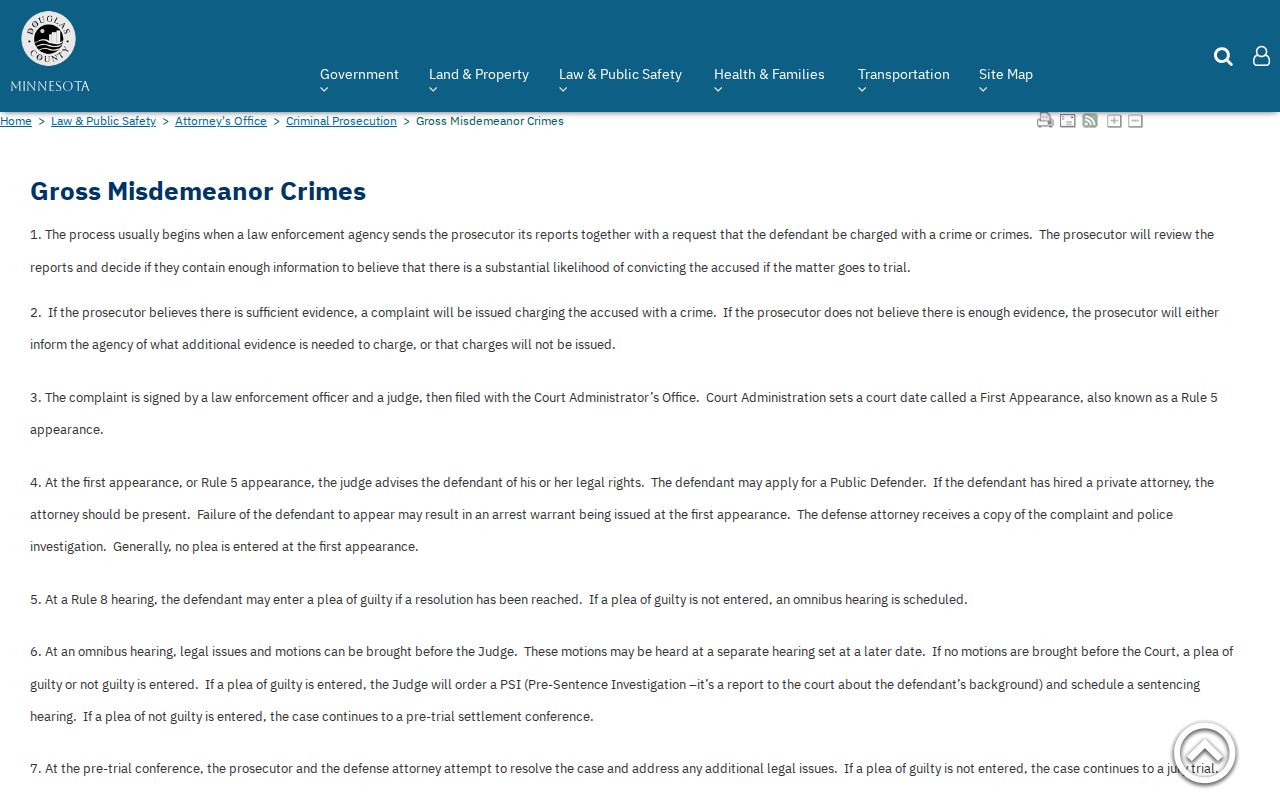
That sequence gives readers a way to track changing Douglas County criminal docket entries. Read no single event as the case's end.
If the matter moves forward, omnibus motions and plea proceedings may come next. A guilty plea can lead to a presentence investigation and sentencing. A not-guilty plea can lead to pretrial settlement work or a jury trial. Each step may show up as a hearing. It can appear as a case event too. Continuances, reassignment, amended charges, or later orders can shift the order of things.
How a Criminal Case Moves
Read a Douglas County criminal docket as procedural history, nothing more. A complaint is an allegation, not a conviction. A bond entry is not a disposition either. Charges get amended, cases get dismissed, and a later plea, verdict, sentencing order, probation condition, or expungement notation can recolor what came before. The best reading order runs from the current charge history to the case events. Then read the charge-level disposition.
Docket flow: Complaint filed → First appearance → Omnibus or pretrial events → Plea or trial → Disposition → Sentencing or later conditions.
"Open" and "closed" are administrative labels only. They say nothing about guilt, explain no outcome, and promise no full remote access to every document. When an official record matters, the detail view and a certified copy from Court Administration control.
Douglas Criminal Docket Calendar Checks
Need a Douglas County court date rather than the whole case file? MCRO Hearing Search is built for that. Search by person or business name, case number, judicial officer, or attorney. Date, category, and location filters narrow the results. One quirk: the judge field can list a judicial officer more than once. So have the case number handy, or pick the matching judge entry. Hearing Search shows scheduled proceedings, though, not the full event history a case record carries.
Douglas County also posts a Weekly Public Court Calendar as a searchable PDF. It appears at 7:00 a.m. on business days. Updates run hourly after that. The Judicial Branch says the printed calendars outside courtrooms and in public lobbies are actually the most current daily version. Always check the calendar against your notice or order. Hearings get continued, reassigned, added, or moved between courtrooms.
Courts That Hold Criminal Dockets
Douglas County District Court is where criminal cases in the county are heard. It sits in Minnesota's Seventh Judicial District. That district is an administrative grouping of ten counties. It is not its own courthouse or its own case-search database. Questions about a specific case belong with the county where it was filed. Locally, Douglas County Court Administration keeps the court file and supports the courtroom calendars.
The District Court's work goes well beyond criminal matters. Civil, family, probate, juvenile, and traffic cases all land there too. Each has its own access rules. Conciliation Court is a division of District Court. It is not a standalone city court. Don't assume a city ordinance or police matter has its own municipal criminal docket either. A state-court criminal or traffic case? The Douglas County District Court file is the court record that counts.
The Judicial Branch's Douglas judicial-officer directory entry gives court-assignment context. For the judge on a particular matter, though, check the current case detail and calendar. Those identify the assignment.
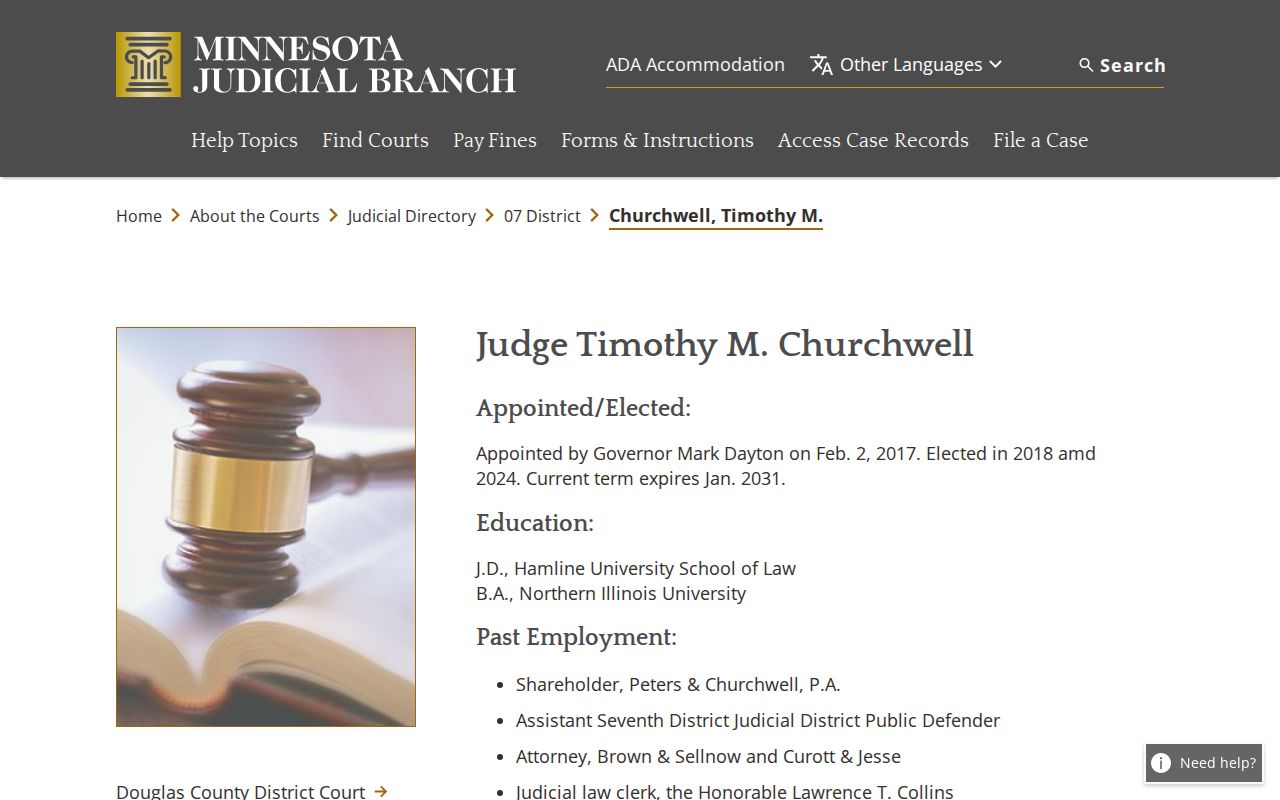
Assignments shift. The Douglas County criminal docket and the current hearing calendar are the records that show which judge has a particular case.
Douglas Criminal Docket Field Terms
Some MCRO labels invite overreading. A hearing is a scheduled proceeding. A case event might be a filing, order, payment, setting, or administrative action. A filed date marks when the court case opened or a complaint entered. It is not the date of the underlying event. The terms below keep a Douglas County criminal docket tied to what the court actually recorded.
- Disposition
- The recorded result for a charge or case, such as dismissal, plea, verdict, judgment, or another resolution.
- Interim conditions
- Conditions recorded while a case is pending; they are not a final disposition.
- Warrant
- A warrant flag or information that may be limited in the remote display and should be confirmed with the court or appropriate law-enforcement office.
- Bond or bail activity
- An entry about amount, posting, or later change that is separate from any finding of guilt.
- Document Index Number
- The link between a case event and a remotely viewable document when online access is permitted.
Sealed Dockets and Public Access
Access rules come from the Minnesota Rules of Public Access to Records of the Judicial Branch. Many Douglas County criminal court records are public. Remote MCRO access is narrower, though. Courthouse terminals provide more. Defendant-name searches can be limited for pending criminal cases without a conviction. Juvenile proceedings carry their own restrictions. So do certain domestic-abuse or harassment matters, civil-commitment materials, sealed records, and other protected filings.
Douglas County access rules.
Minnesota Statutes section 13.90, subdivision 2 recognizes that Supreme Court rules govern access to Judicial Branch records.
Minnesota Statutes section 609A.03 provides the expungement petition and hearing framework.
Minnesota Statutes section 260B.163 addresses juvenile hearings and access, which are not interchangeable with adult criminal dockets.
Sealed or confidential non-adoption records follow a different route. The Judicial Branch points requesters to the CON100 and CON101 access process. Your request states the county and the case information. It also covers your interest, the specific records, and your reason for access. No filing fee is stated for the request itself. A judge makes the call on access. Copies can still cost money.
Douglas Criminal Docket and Sheriff Records
A court docket, a booking record, and an incident report are three different things. Each lives in a different channel. Douglas County names its Sheriff's Records Division as the source for law-enforcement records. That office will not have a criminal case's Register of Actions. Nor its court setting, certified court judgment, or judicial order. For the state-court file, turn to MCRO. Or use courthouse terminal access where available, or Court Administration.
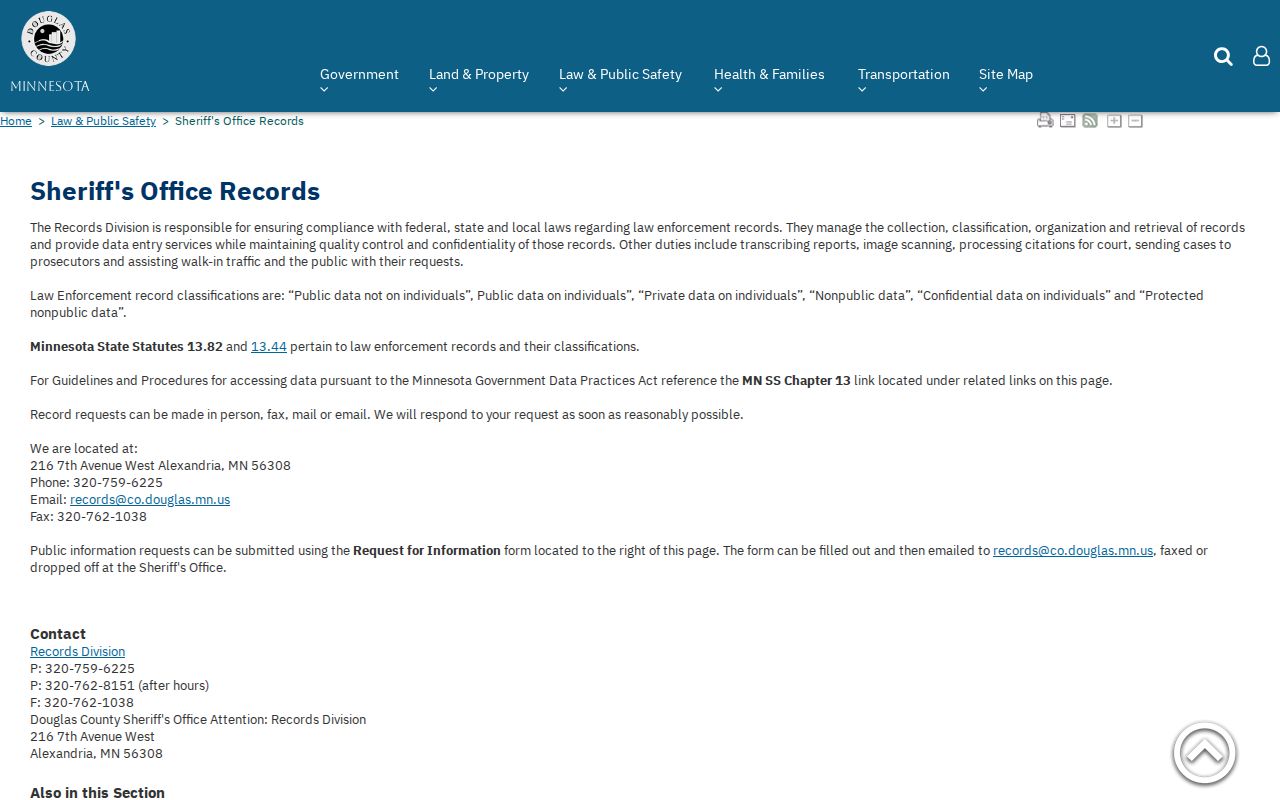
Separate the two and you save time. Keeping the Douglas County criminal docket apart from law-enforcement source records means you request the record that actually answers your question.
Douglas Criminal Docket Federal Split
MCRO stops at the state line of Minnesota's own courts. It holds no federal criminal cases. Those live in PACER and the U.S. District Court, District of Minnesota. The Fergus Falls federal courthouse page covers the closest federal courthouse for Douglas-area users. It adds location context. Keep state and federal case numbers, filing systems, and access rules apart.