
Getting Douglas County Court Records
Court Administration runs the District Court's files for Douglas County. Its reach spans civil, family, criminal, juvenile, probate, traffic, and jury matters. Bring a case number if you have one. Then name what you want, whether an order, a judgment, a document index entry, a hearing record, or a certified copy. The Judicial Branch offers several channels. You can pull remotely viewable documents through MCRO, file by eFiling, or visit a public courthouse terminal. You can also request in person or by mail. When remote results leave a Douglas County record question open, Court Administration is the local contact. It answers procedural questions within staff authority.
- Use MCRO Case Search to locate the Douglas County file and confirm its number, type, and court location.
- Use Document Search when the complete case number is known and a document may be remotely available.
- For an official copy, contact Douglas County Court Administration in person, by phone, or by mail and state whether the copy is uncertified, certified, exemplified, or a transcript.
- Use eFiling when that request route is permitted, or call ahead before visiting a MNPAC terminal because the Douglas terminal room is not identified online.
The statewide form index lists no special Douglas County copy-request form. A clear letter works instead. Identify the case, the document, the certification type, the delivery method, and your contact information. Make checks or money orders payable to "District Court Administrator." Follow the copy guidance on amounts. Keep two other routes separate. The county public-data request and the Sheriff's records channel are not part of the Douglas County court file.
Douglas County Docket and Case File
The Register of Actions is often labeled Case Events. It is the docket index for Douglas County and its chronological event history. It shows that something was filed, ordered, scheduled, paid, or recorded. Nothing more. Behind that index sits the full court record. That record can hold pleadings, orders, judgments, exhibits, and a written transcript. A Document Index Number links a Case Event to a document you can view remotely when access is permitted. Even so, that link does not promise an online image for every event.
The Judicial Branch district-court fee page separates copy categories and certification choices. 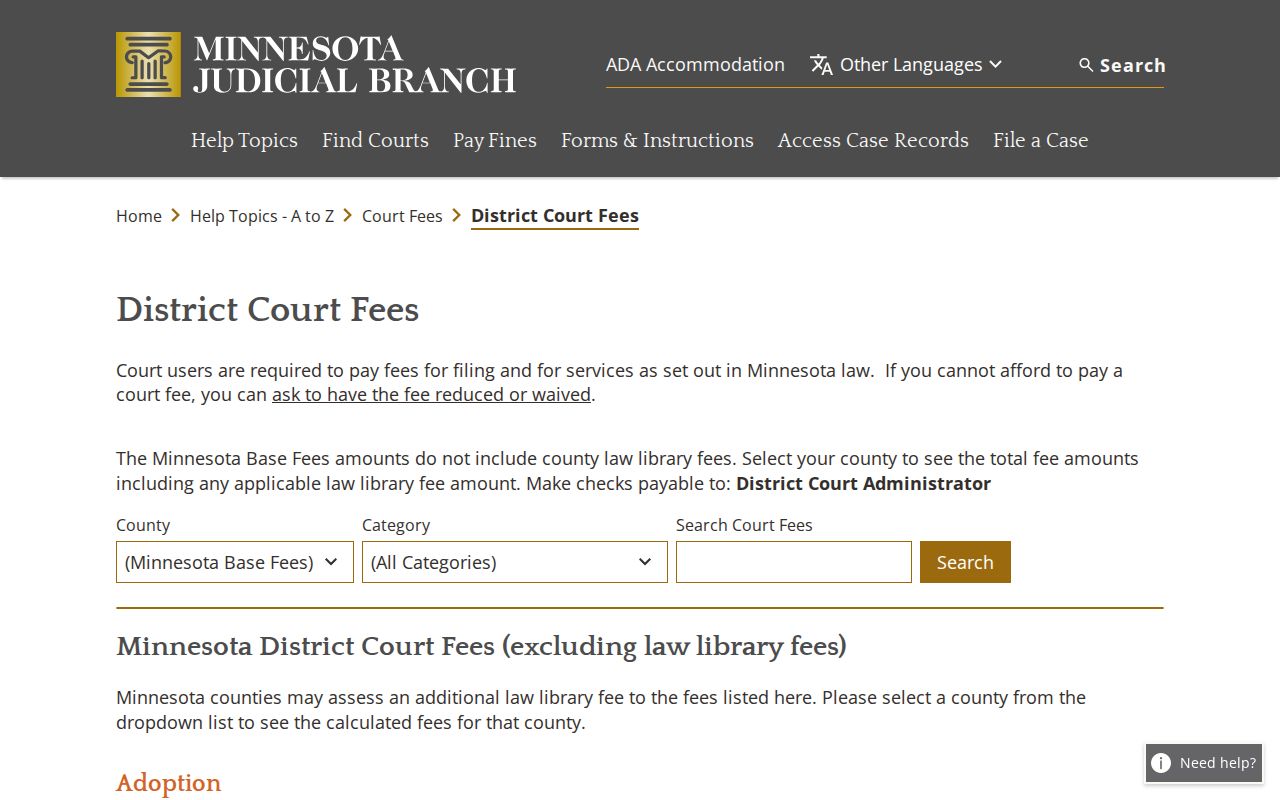 The statewide controls identify the type of copy, while the Douglas County request still needs the correct local case and document description.
An MCRO printout is handy for locating a Douglas County record. MCRO itself states it is not an official certified record, so get certified copies from Court Administration. Keep the distinctions straight: a viewable document is not automatically certified, and a certified record is not an exemplified copy.
Court Record Types
What sits in a Douglas County court record depends on the case type and the stage of the proceeding. A case file may hold the Register of Actions, pleadings, motions, affidavits, signed orders, judgments, financial entries, and any document images open to the public. Criminal files can carry charges, amended charges, and warrants. Interim conditions, bond or bail activity, disposition, and sentencing information can also appear. On the civil side, expect complaints, answers, motions, judgments, garnishments, and satisfactions. The label on an item does not settle its status. Governing access rules decide whether a Douglas County item is public.
- Case Events and the Register of Actions provide the dated Douglas County file history.
- Orders, opinions, notices, and qualifying judgments can be remote documents or clerk copies.
- Pleadings and motions are filed documents that may have a Document Index Number.
- Financial and judgment details record listed fines, fees, payments, credits, awards, or satisfaction information.
- Written transcripts are the official record of a proceeding and follow a separate request path.
Court Administration can tell you whether a copy exists. Staff cannot unlock a protected item, though. Before drafting a Douglas County copy request, use the statewide MCRO categories to sort Civil, Criminal, Family, Probate, and Mental Health cases.
Douglas County MCRO Record Coverage
Through MCRO, many qualifying documents filed on or after July 1, 2015 are viewable from a distance. Eligible case types include major and minor criminal and civil cases, formal and other probate matters, guardianship and conservatorship cases, and trust cases. Certain judgments, orders, opinions, and court notices filed from July 1, 2005 through June 30, 2015 also get remote access. That coverage aids a Douglas County document search. Still, it promises nothing about every filing in an eligible case being online. Family and post-adjudication paternity records have a slimmer remote set. These are generally court-prepared orders, opinions, and notices. So in a Douglas County case, you might see the case shell or an event but not a particular filing. Remote absence can stem from confidentiality, sealing, or expungement. It can also stem from old digitization limits, or a pending criminal, traffic, or petty-misdemeanor matter with limited name-search visibility.
The official copy-request overview distinguishes uncertified, certified, and exemplified copies. 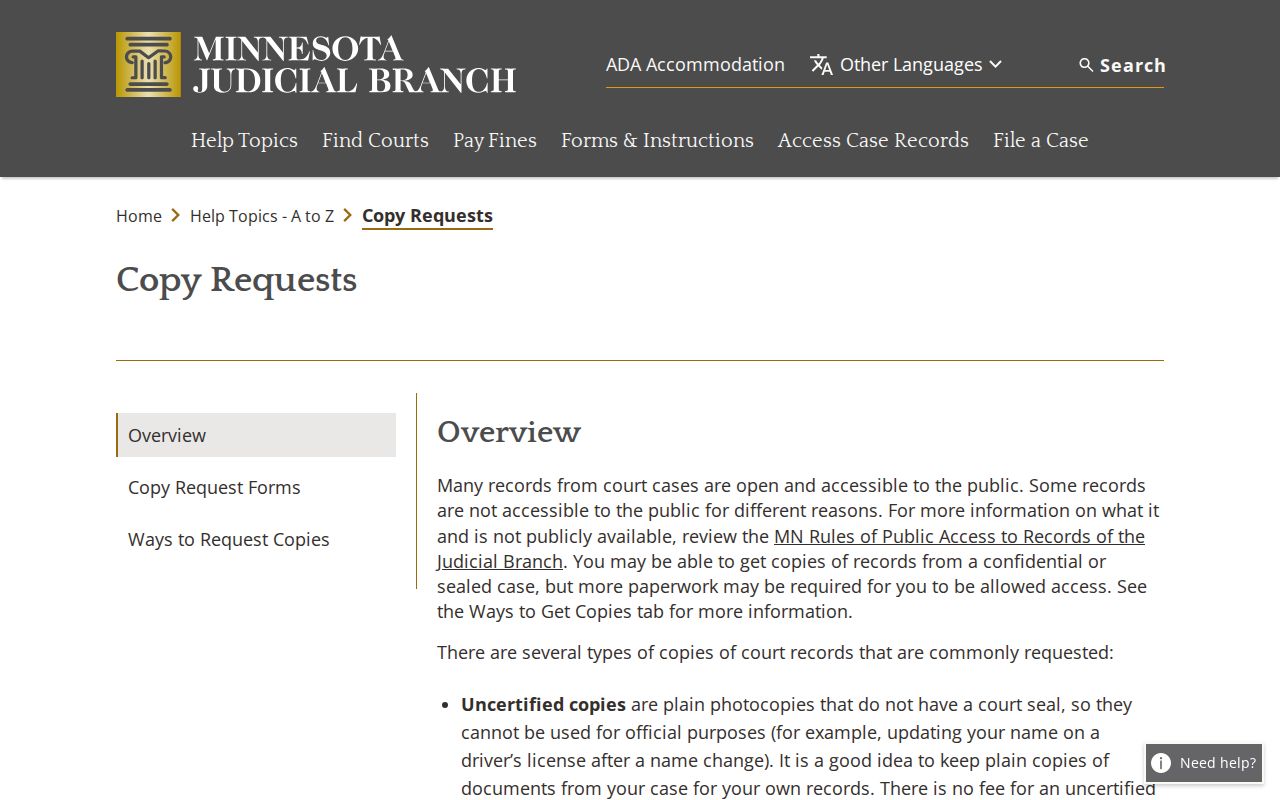 Choose the copy type before asking Douglas County Court Administration to prepare it, since certification changes both the process and fee category.
Note: A Douglas County document missing from remote view may simply reflect an access limit. It does not mean the court file lacks the document.
Inside a Douglas County Court Record
MCRO's official field inventory sorts a Douglas County case into Overview, Case Information, Party Information, Warrants, Charges, Interim Conditions, Case Assignment, Case Events, Hearings, Dispositions, Bond or Bail Activity, Financial Information, and, where relevant, Judgment Details. That layout can identify a court file. Read each field in context, though. A filed date marks when the court file was opened or a complaint or petition was entered. The underlying event may have happened on a different date.
| Case Number / Location | Identifies the Douglas County file and venue. Keep both with any records request. |
|---|---|
| Case Events | Reverse-chronological entries showing filings, orders, settings, payments, or administrative action. |
| Document Index Number | Links an event to a remotely viewable image when access is permitted. |
| Hearings and Dispositions | Show settings and recorded outcomes. A hearing is not every case event. |
| Financial or Judgment Details | Can show listed obligations, payments, credits, awards, and satisfactions where applicable. |
Party fields may list a role, name, city or state, aliases, and attorney, though the remote display holds back some sensitive details. Treat an open or closed status as administrative bookkeeping. It says nothing by itself about a Douglas County disposition, whether a judgment was satisfied, or whether the record is public.
Douglas County MNPAC Terminals
MNPAC is the terminal system inside the courthouse for Douglas County court records. Minnesota Public Access screens sit in the building itself. The Judicial Branch says registers of actions reach these terminals. Public access to case documents spread to terminals in every state courthouse in 2014. In some categories a MNPAC terminal can show more documents than remote MCRO offers. Still, confidential and sealed files stay off limits. A terminal is never a loophole around a court access rule.
Where exactly are the terminals? Douglas County court pages do not say. Calling Court Administration first makes sense before any terminal-focused trip, above all when you also need a file room, a judge, or a court reporter. The courthouse stands at 305 Eighth Avenue West in Alexandria. Free surface-lot and on-street parking appear on the court page. One wrinkle exists. The county office page places Court Administration at 720 Elm Street. Its mailing address is 305 Eighth Avenue West. Confirm your destination before you drive.
Each channel serves a different Douglas County purpose. Remote MCRO handles discovery from home, while MNPAC gives in-person public access. Court Administration answers official local records questions. Keeping those roles straight also stops a county general-data request from standing in for Judicial Branch access rules.
Fees and Certified Copies
Douglas County Court Administration hands you the official copy. The statewide fee schedule sets the price. Uncertified instruments, printouts, scans, and screen prints all list at $0, though category and county add-ons may apply. A certified instrument costs $14, and that same figure covers standard certified MNCIS, e-file, or screen-print categories. Want a copy that is both certified and exemplified? That runs $28. An exemplified but uncertified copy is $14. Generated reports cost $5 for 1 to 50 pages, then $25 for each 50-page increment or part beyond that, and scanning also runs $25 per 50 pages or part.
| Douglas County Court Record Item | Statewide Listed Amount | Request Note |
|---|---|---|
| Uncertified instrument, printout, scan, or screen print | $0 | Subject to category and county add-ons; confirm the Douglas total. |
| Certified instrument / certified MNCIS, e-file, or screen-print category | $14 | Ask for the precise certification needed. |
| Combined certified and exemplified copy | $28 | Use only when both certifications are required. |
| Generated report, 1-50 pages | $5 | Over 50 pages adds $25 per 50-page increment or part. |
| Scanning | $25 per 50 pages or part | Confirm whether staff must dismantle a Douglas County file. |
Douglas County Court Administration
Douglas County Courthouse
305 Eighth Avenue West
Alexandria, MN 56308
(320) 304-6050
Most certified copies made in person can come out the same day. Offsite or archived files take longer. The statewide fee page does not list the Douglas law-library add-on, so ask Court Administration for the true total before submitting any copy request.
Douglas County Copy Request Paths
The state’s copy-request channel guidance describes MCRO, in-person, mail, and eFiling routes. 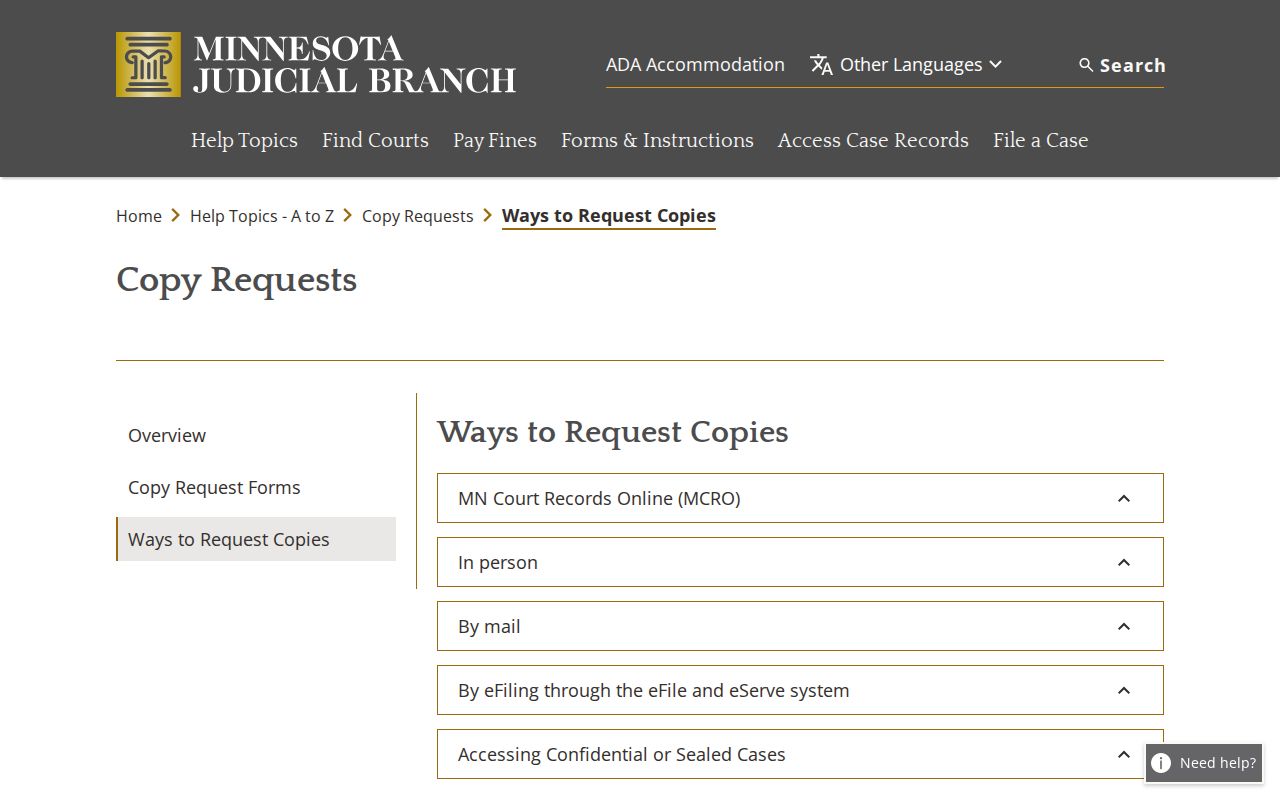 In Douglas County, the local request should identify the case, document, copy type, delivery method, and contact information whether it is mailed, presented at the counter, or sent through a permitted eFiling channel.
A phone call works well for confirming things in Douglas County. It cannot replace a focused request. Dial (320) 304-6050 to confirm the court location. Learn whether a file sits locally or offsite. You can also get routed on terminal, reporter, or certified-copy questions. The county Public Information Office and the Sheriff's Records Division handle county and law-enforcement records. Neither holds the District Court case file.
Transcripts run on their own track. The official record of a proceeding is the written transcript, never the audio. Your request should name the Douglas County file number, the proceeding date, and the hearing. Pay the reporter first; preparation starts only then. Statewide page rates exist. No Douglas reporter contact or local transcript form is published, so Court Administration is your proper starting point.
Note: ask for one Douglas County case and one identified record. That clear ask beats a broad sweep of a person's whole history.
Sealed Records and Public Access
One rulebook controls Douglas County court-record access. It is the Minnesota Rules of Public Access to Records of the Judicial Branch. A generic county request rule cannot override it. Rule 4 sets out which records are public and which are nonpublic. Rule 8, subdivision 2 restricts remote access. Minnesota Statutes section 13.90, subdivision 2 confirms that Supreme Court rules govern judicial-branch records. Section 13.03 supplies the general government-data baseline, but those court rules still control.
Douglas County access rules:
Minnesota Statutes section 13.90 recognizes the Supreme Court’s authority over judicial-branch record access.
Minnesota Statutes section 13.03 supplies the general data-request framework but does not override court confidentiality.
Minnesota Statutes section 609A.03 provides the expungement petition and hearing framework.
Minnesota Statutes section 260B.163 addresses juvenile hearings and access.
Sealed or confidential non-adoption records need the Judicial Branch's CON100 instructions and CON101 request. The form asks for the county, the case, your interest, the precise records, your reason, a signature, and contact details. A judicial officer makes the call. Filing that access request costs nothing, though copies may. Adoption records go through ADO601 instead. Court Administration accepts the permitted filing route, but an ordinary Douglas County copy request can never unlock a record that needs judicial approval.
Douglas County Written Transcripts
A transcript is a written account of a hearing. No downloadable audio substitutes for it. Douglas County requesters should give Court Administration the file number, the proceeding date, and the hearing details. Then the local reporter path can be confirmed. The reporter gets paid before the written record is prepared. Statewide guidance sets the page rates. $4.25 covers criminal or juvenile matters. Civil, family, probate, child-protection, and related categories cost $5.75. The court pays $4.25 when it covers an indigent party.
The official guidance provides electronic transcripts. Paper may not be an option. No Douglas-specific reporter contact or local form is published. So do not expect a standard copy request to produce a transcript. Once you have the case and hearing identified, ask Court Administration to route a targeted Douglas County transcript request.