
Searching the Douglas County Court Docket
Minnesota Court Records Online, or MCRO, is where most Douglas County court docket searches begin. You can search by Name, Case Number, Citation Number, or Attorney. A bare name search can pull in people from across the state. Narrow it whenever you know those details. Use the Douglas court location, a case category, or a filed-date range. That keeps unrelated hits out of your Douglas County results.
Have the full case number handy. It shows up on notices, orders, and payment records. If a traffic citation is all you have, MCRO accepts the citation number instead. Before treating a hit as the right file, compare the details. Check the listed court location, filing date, case category, party role, and case number. One caution applies. MCRO lets the public view court records. But it is not a certified copy of any court record.
- Open MCRO Case Search and choose the mode that matches the information in hand.
- Set Court Location to Douglas before relying on a broad name result.
- Add a category or filed-date range when a name returns too many matches.
- Open Case Details and read the Register of Actions, hearings, documents, and disposition fields.
- Ask Douglas County Court Administration for a certified copy or confirmation when an official record is needed.
Douglas MCRO Docket Filters
MCRO splits its search modes for a reason. Person search starts from a last name. Add a first or middle name to cut the results down. A trailing wildcard needs at least two characters first. Sounds Like works on its own rather than alongside a wildcard. Business search takes the business name. Attorney search helps when you know the lawyer. A bar number beats a common surname for precision.
The categories run from Civil to Criminal, Family, Probate, and Mental Health. Those filters keep a Douglas County docket search from reading one name hit as a full case history. Case status appears as a filter too. Its labels vary, so read them straight from the live system. After changing the county or date range, use the Find and Clear controls. They start the docket search over fresh.
| MCRO field | Use in Douglas County | Helpful detail |
|---|---|---|
| Name | Unknown case number | Choose Person or Business, then set Douglas. |
| Case Number | A notice or order supplies the number | Omit dashes or leading zeroes if needed; do not add spaces. |
| Citation Number | A traffic citation is available | Use the complete preprinted identifier. |
| Attorney | Counsel is known | A bar number can narrow a common name. |
Inside a Douglas County Court Docket
Minnesota labels its docket history the Register of Actions, sometimes called Case Events. It lists dated court activity and nothing more. Case Details packs a lot in. It holds the file number, case type, venue, judicial officer, status, parties, attorneys, related cases, events, hearings, documents, dispositions, and financial information. An open status is administrative. It is not a finding of any kind. A closed file is not automatically a fully public one either.
Read party roles instead of assuming a name means an accusation or an outcome. The Filed Date marks when the court opened or entered the matter. It may not match the date of the underlying event. A hearing is a scheduled proceeding. Not every case event rises to that level. For real context, look at the exact event. Then check any controlling order in the Douglas County court docket.
| Case Number | Identifies the court file. Copy the number from the record rather than reconstructing it. |
|---|---|
| Case Event | A dated filing, order, payment, setting, or administrative action in the Register of Actions. |
| Document Index Number | Links an event to a remotely viewable document when access is permitted. |
| Hearing | Shows a past or upcoming setting; it is distinct from the full event history. |
| Disposition | States the recorded result, such as dismissal, plea, verdict, or judgment. |
| Financial Information | May show fines, fees, payments, credits, or a balance recorded by the court. |
Douglas Docket System Roles
Three Minnesota systems do different jobs with court records. MCRO is the public remote layer, serving selected public case records and documents. MCRO’s official overview lays out its coverage and limits. Minnesota Public Access, called MNPAC, is the terminal layer inside the courthouse. It can offer broader in-person reach into public registers and many document images. Confidential and sealed material stays off limits no matter what.
Minnesota eFile and eServe, known as eFS, handles filing and service. Public docket viewing is not its job. Attorneys, government agencies, and guardians ad litem have faced statewide mandatory eFS use since 2016. Self-represented filers may opt in where allowed. A filing receipt proves only that papers went in. It does not replace the Register of Actions or show that a judge ruled.
The Judicial Branch terminal announcement records the 2014 expansion. It made case documents viewable on state-courthouse terminals.
Planning to use a public terminal or request a file from the room where paper records sit? Call Douglas County Court Administration first. The local pages never name the exact room, so one quick call saves a wasted trip.
Courts That Keep Dockets in Douglas County
Douglas County District Court is the trial court of general jurisdiction here. It handles civil, family, probate, juvenile, criminal, and traffic cases across the county. It belongs to the Seventh Judicial District. That district covers ten counties in all. The district office coordinates administration for the region. The county court still keeps the actual Douglas case file.
Conciliation Court handles smaller civil claims. It sits as a division of District Court, not a separate municipal court. Cities can enforce their own ordinances. Yet none of the five largest Douglas County cities offers an official municipal docket search, a municipal judge roster, or a city-run public calendar. Once a city matter turns into a filed state-court case, the Douglas County District Court docket is where the search belongs.
| Court or layer | Docket covers | Where to search |
|---|---|---|
| Douglas County District Court | Civil, family, probate, juvenile, criminal, and traffic cases | MCRO, MNPAC, and Court Administration. |
| Seventh Judicial District | District administration across ten counties | Confirm the county that filed the case, then use that county court. |
| Minnesota Court of Appeals | Intermediate appellate matters | Not the normal starting point for a Douglas trial-level docket. |
| Federal courts | Federal civil, criminal, and bankruptcy matters | PACER or the appropriate federal CM/ECF system. |
The Seventh Judicial District page lays out the regional structure around Douglas County. That structure shapes how cases are routed, though the county court itself remains the keeper of local dockets.
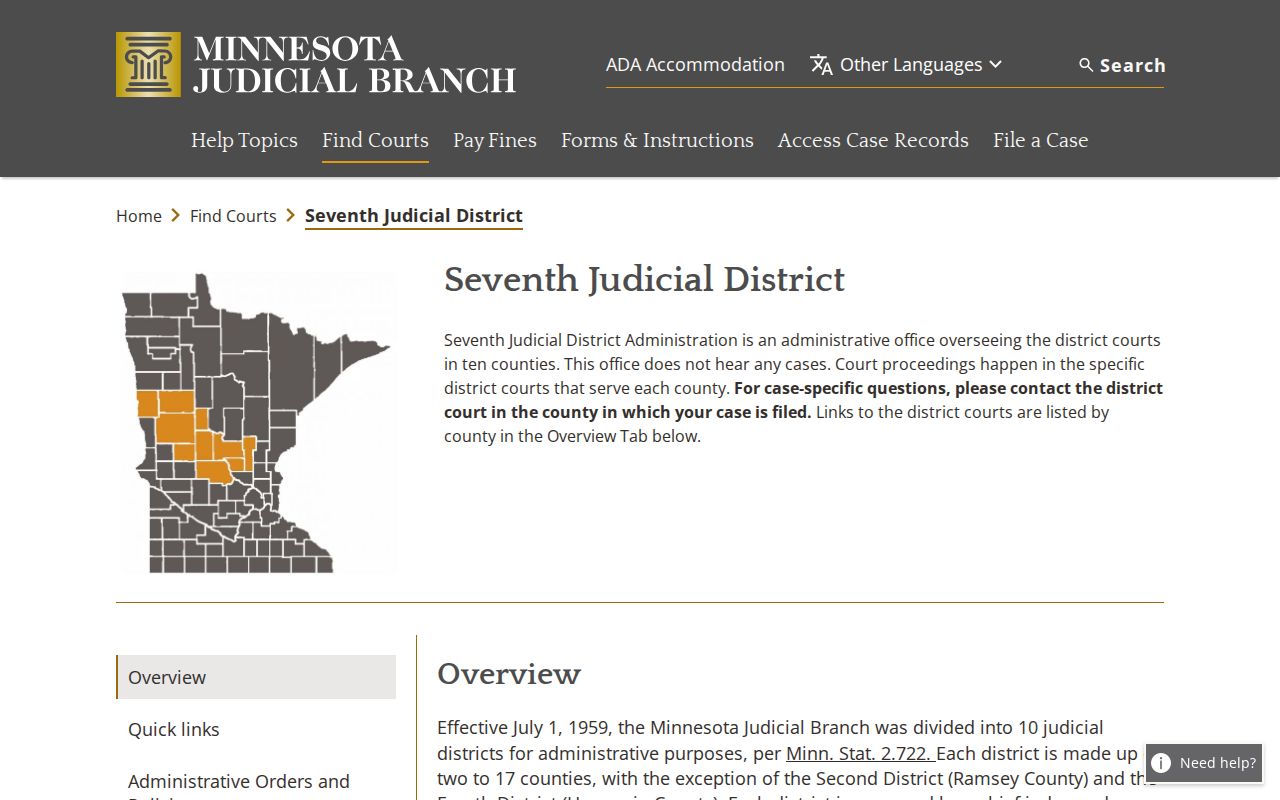
The regional map helps you picture the district. For a Douglas County case lookup, though, the county location filter is the detail that matters.
How to Find Douglas County Court Dates
Start with the Douglas County Weekly Public Court Calendar. It's a searchable PDF listing hearings set for courtrooms. It is not a full court docket, though. The clerk posts it at 7:00 a.m. every business day and refreshes it hourly, yet a hearing can still move. Before you rely on a date, check it against the notice or order in the case file. Dates matter most when an appearance is required.
MCRO Hearing Search works alongside the calendar. Search by person, business, case number, judicial officer, or attorney, and narrow by hearing date, category, or location. For same-day questions, printed calendars outside courtrooms and in public lobbies are the most current daily reference named by the Judicial Branch. One caution. If a name shows no hearing online, that does not mean the hearing was cancelled.
Douglas Court Calendar Freshness
The official Douglas court page makes the limits plain. The weekly public calendar covers scheduled courtroom hearings. It does not cover every court matter. Anything confidential stays off the posted calendar. So do cases restricted from remote access under Rule 8, subdivision 2. A judge, courtroom, or setting can be added, continued, reassigned, or moved after you download the PDF.
So a court setting and a case event are different things. An upcoming setting may show up in Hearing Search. Work done in chambers never reaches the public calendar. Neither do protected matters or events with no courtroom appearance. For anything date-specific, call Court Administration at (320) 304-6050.
The official Hearing Search interface lays out the fields for checking a Douglas County court date.
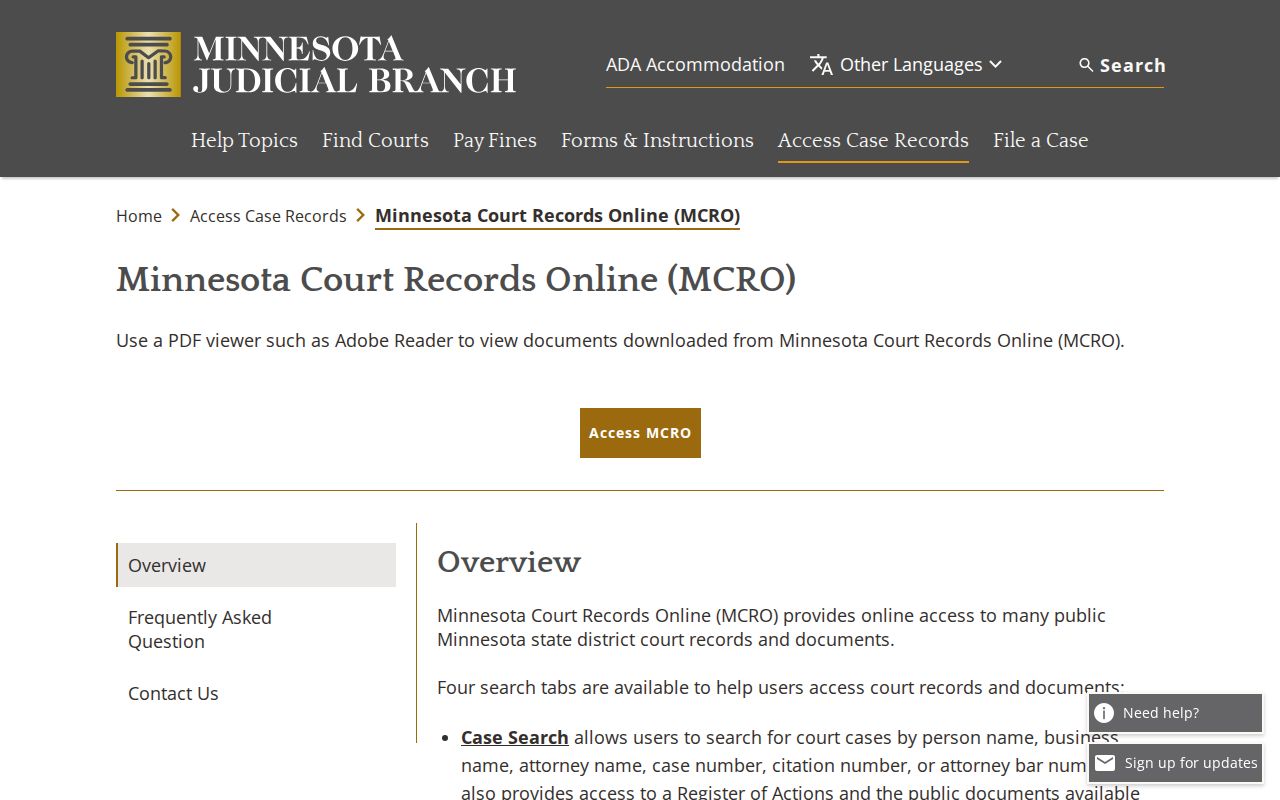
The live tool finds public settings fine. For an appearance question, the current court notice plus a call to Court Administration still controls.
Public Access to Douglas County Court Dockets
Access to Minnesota court records rests on the Minnesota Rules of Public Access to Records of the Judicial Branch. Many Douglas County court records are public. Remote access is narrower, though. Rule 4 covers which records are public and which are not. Rule 8, subdivision 2, sets the remote-access limits. That calendar warning means some cases stay off the list.
MCRO is not a certified record either. Domestic-abuse and harassment cases, CHIPS, some juvenile matters, civil-commitment documents, adoption records, and other protected material may be limited or missing remotely. Pending criminal, traffic, and petty-misdemeanor cases without a conviction can also be hidden from defendant-name searches. A blank screen proves nothing about whether a case exists.
Key Rules:
Minnesota Rules of Public Access define what court records can be accessed and when remote access is narrower.
Minnesota Statutes section 13.90 recognizes that Supreme Court rules govern judicial-branch record access.
Minnesota Statutes section 609A.03 supplies the petition and hearing framework for expungement.
Minnesota Statutes section 260B.163 addresses juvenile hearings and access limits.
Douglas Court Docket Access Limits
Can't find a Douglas County case? Check the spelling and any aliases. Check the county selected, the exact citation or case number, and a sensible date range. Protected family, juvenile, domestic-abuse, harassment, commitment, or delinquency matters may need a different access route. Searching by case number sometimes returns limited information when a defendant-name search returns none.
Confidential or sealed record requests that are not adoptions go through Minnesota's CON100 instructions and the CON101 request process. The requester states the county and district, the case number or type if known, the specific records wanted, an interest, and a reason for access. A judicial officer then rules on the request. Adoption records follow the separate ADO601 process, not CON101.
Note: A narrow request works better than a broad one. Ask for a known case, document, hearing date, judgment, or certified copy, not everything about a person.
Docket Records at Douglas Clerk's Office
Douglas County has no separately elected clerk under that title. The office that runs the docket here is Douglas County Court Administration. It keeps the filings and processes cases. It supports the calendars and administers juries. It handles copy requests and answers procedure questions within staff limits. It cannot give legal advice or release restricted information just because someone asks.
When you request copies, give the case number if known. Then list the case type, a party or business name, a filing or hearing date, and the exact document. Say whether you want an uncertified, certified, or exemplified copy, a transcript, or an electronic document. MCRO works for a remote public view. Court Administration supplies certified copies and local answers.
Douglas County Court Administration
Douglas County Courthouse
305 Eighth Avenue West, Alexandria, MN 56308
(320) 304-6050
Monday-Friday, 8:00 a.m.-4:30 p.m.
The county Court Administration page lists a 720 Elm Street office location and the courthouse address for mail. Call ahead before any terminal, file-room, judge, or reporter visit. The official pages never name the public-terminal room.
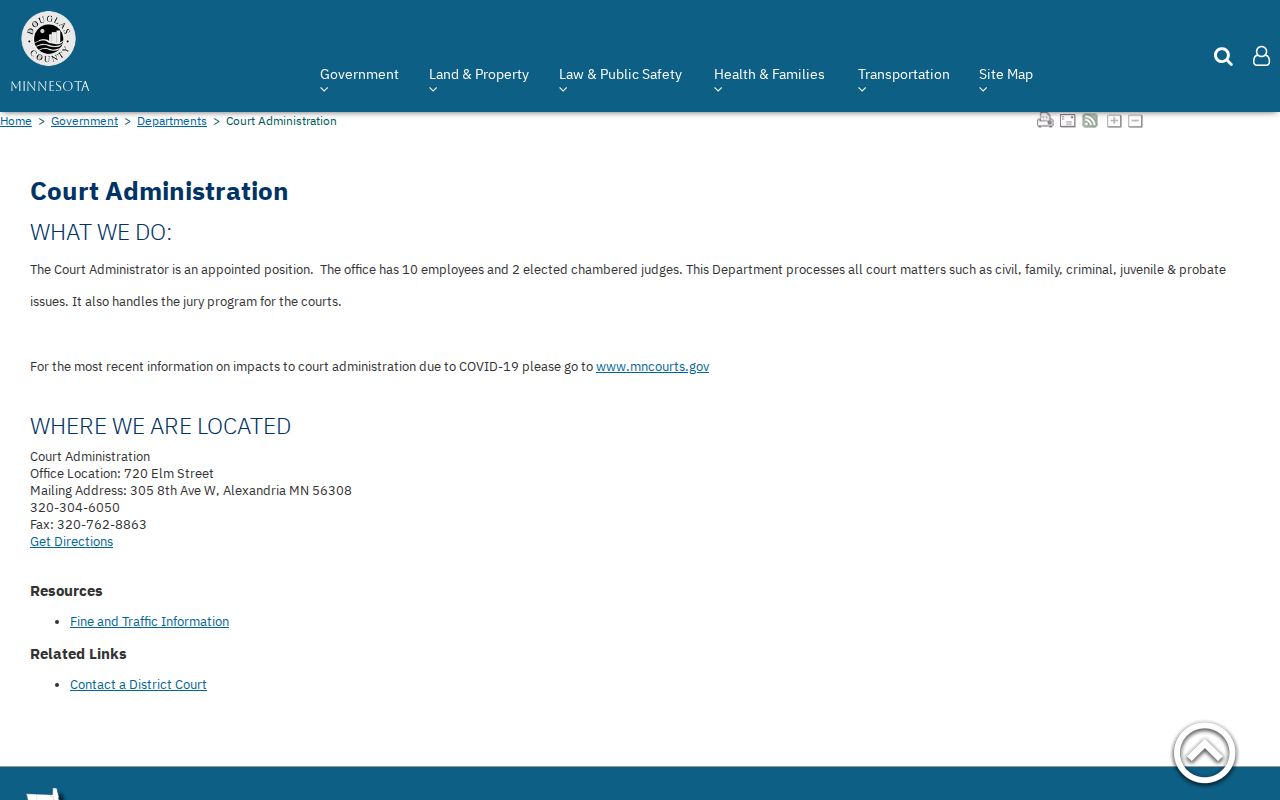
The department details help separate a courtroom trip from mailing something in. They also distinguish a specialized records or terminal request.
Douglas Court Docket History
The Douglas County docket runs deep in local history. The county was organized in 1866. Its official courthouse history says court first met in a small Main Street frame building shared with the Alexandria Post. A two-story frame courthouse came in the 1870s. Then the towered brick courthouse went up in 1895, complete with oak woodwork and tiled floors.
Modern access arrived in steps. Courthouse terminals first opened public registers. Public document viewing expanded at terminals in 2014. Douglas then joined the statewide eFiling and eService rollout in December 2015. MCRO later layered on remote documents, cases, hearings, and judgments. So an old file and a new one can look very different online, even though both sit in the same county court system.
The official courthouse history tells the full local story behind that record.
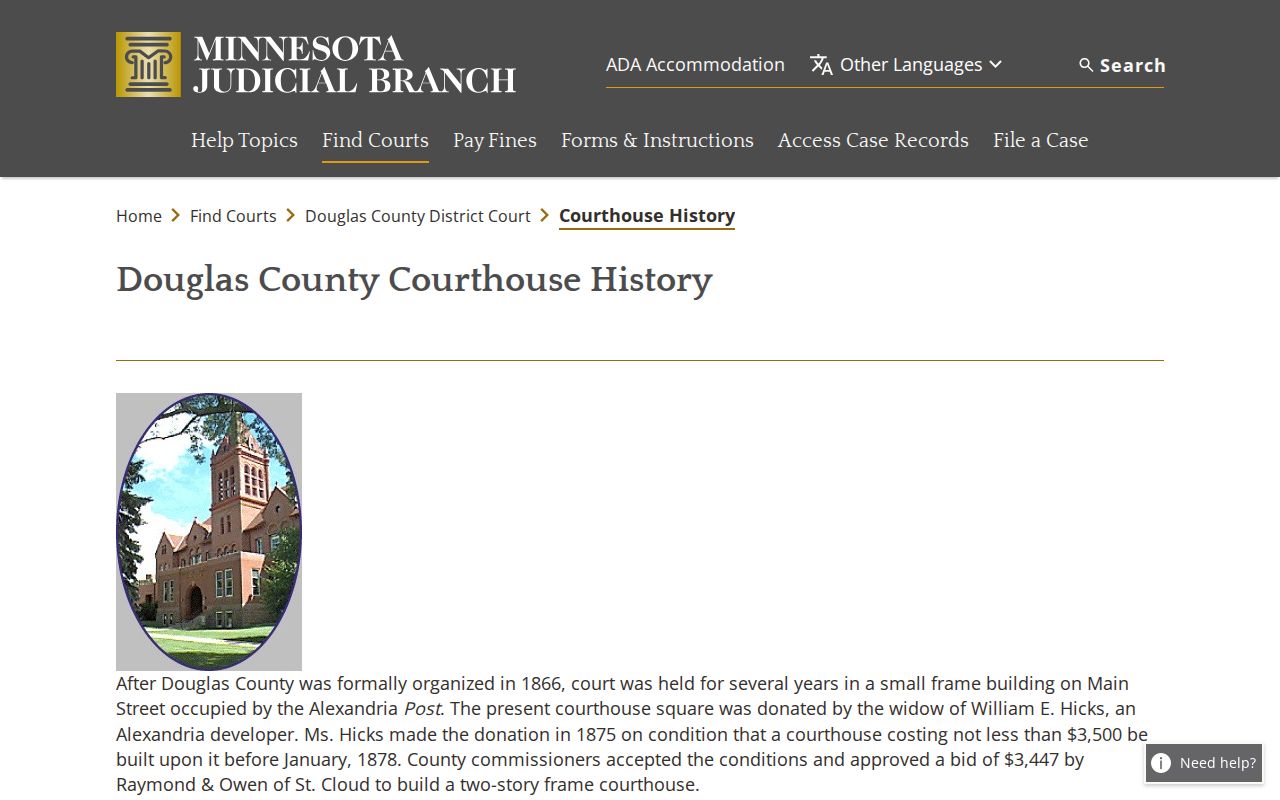
Douglas County's courthouse past explains a present-day puzzle. Record custody, court location, and public access remain three separate questions for anyone using a Douglas County court docket.
Douglas Docket Search Troubleshooting
MCRO caps results at 200 and sorts Newest First. That cap matters. If a search could run past the limit, narrow it with Douglas County, a date range, a category, or a first name rather than treating the first page as complete. The results view also offers Oldest First, Print, and View Case Details. Case Details is where the real docket lives: Register of Actions, hearings, documents, disposition, and financial fields all sit there.
Pick Document Search with a complete case number. Use it for a document you can reach remotely. Judgment Search covers recorded judgment information, including All, Active, or Inactive status, but it is not a full case lookup. When a known case still will not appear, Douglas County Court Administration can sort out whether the trouble is a county filter, an identifier, an access restriction, or the wrong record custodian.
- Register of Actions
- The dated procedural history of filings and court activity.
- Case Event
- An individual item in that history, such as an order, hearing, payment, or filing.
- Disposition
- The recorded result for a charge or case, which must be read with related entries.
- Satisfaction
- An entry showing that a monetary judgment was satisfied where recorded.
Douglas County Court Dockets by City
Alexandria, Osakis, Evansville, Brandon, and Carlos rank as the five largest incorporated Douglas County cities in the official 2020 Census. Each keeps civic records and local context, but none of them runs its own searchable municipal court docket. Any filed state matter, whether civil, criminal, family, probate, juvenile, or traffic, belongs to the Douglas County District Court routing system. City ordinance and council materials go to the city administration that holds them.
These city pages help separate two things. One is a municipal record question. The other is a Douglas County court record, court date, citation, or certified-copy request. A city name makes a useful search clue. Still, some identifiers hold up in any docket search. The county location, case category, and case number carry that weight.
Alexandria Docket Search
Population 14,335. County-seat routing and city-versus-court record distinctions.
Osakis Docket Search
Population 1,771. City data forms and ordinances remain separate from court files.
Evansville Docket Search
Population 603. Council records and the county court docket serve different purposes.
Brandon Docket Search
Population 501. Use the county route while the official city site’s availability is confirmed.
Carlos Docket Search
Population 497. The city ordinance library is distinct from the MCRO case system.
Douglas Court and Sheriff Records
Several offices in Douglas County hold different materials. Court Administration keeps court records. The Sheriff's Records Division, the county Public Information Office, city clerks, and the Recorder each hold their own pieces. An incident report, booking record, or law-enforcement citation source stays with the law-enforcement office that keeps it. A filed complaint, hearing history, judgment, case event, or certified court record belongs with the court system.
The Douglas County Sheriff's records page covers that separate law-enforcement channel. It does not replace a Register of Actions or a court copy request. Federal cases take another route entirely, since MCRO does not retrieve federal dockets.
Map and Directions to the Douglas County Courthouse
Douglas County District Court files are kept at the Douglas County Courthouse, 305 Eighth Avenue West, in downtown Alexandria. Court Administration processes filings, case records, and calendar matters from the courthouse, though the county's department page separately lists an Elm Street office location with the courthouse address used for mail. Visitors and mail should default to the courthouse address unless Court Administration directs otherwise.
Douglas County Court Administration
Douglas County Courthouse
305 Eighth Avenue West
Alexandria, MN 56308
(320) 304-6050
Monday-Friday, 8:00 a.m.-4:30 p.m.
The official court page lists a free public surface lot and free on-street parking at the courthouse. Because the exact public-terminal or file-room location is not published, calling Court Administration before a specialized visit avoids an extra trip.